Saturday, 1 September 2012

Digging up Georgian Margate


Digging up Georgian Margate.

Finding any item apart from coins and tokens relating to Georgian Margate is a very difficult task due to the modern development of the Margate. Even though many fine Georgian buildings remain in the town today it is very difficult to find any items relating to life in Georgian Margate apart from the artwork and archive records in the local Margate museum.

 Since the construction and opening of the stone pier in 1815 and the construction of the sea wall that forms Marine Terrace there has been a continuous build up of sand and silt in the area.  This in turn has buried some evidence of life in Georgian Margate under layers of silt and sand in the harbour and main sands area. With items remaining buried and only accessible when there is sand erosion due to storms or during sea defence construction and repair works.

In the past there have been opportunities to find Georgian items like the aftermath of the storm of 1978 that destroyed the Jetty. The demolition and clear up that followed and the construction of a new sea defence behind the Droit house in 1985 did lead to a few finds. Most of the finds being George II, George III and George IV coins and tokens that were found using a metal detector as this was the only search option because of tidal conditions. Other items made of lead and copper were also found but it was difficult to date these items and establish a provenance from the Georgian period because of the abundance of Victorian items in the area originating from the Jetty and the Victorian Marine Palace site at the Rendezvous car park.  Examinations of all old non metallic items found in the area at the time were found to be all Victorian, Georgian items like ceramic and glass were found to be nonexistent in these areas.

The under pinning works of the Stone Pier in the spring of 2012 provided another  window of opportunity as the excavations that were to take place would lead to some deep digging in the Harbour area. Digging took place close to base of the stone pier wall and sheet piling was driven in and then capped with concrete. Old underpinning from the 1953 reconstruction work was also removed from around the square head area and the lighthouse and replaced. During the 2012 underpinning works a few Georgian items were found during excavation and these items were spread over a wide area, this was probably due to the fact that dredging took place in the Harbour in the 19th century for the paddle steamers and later in the 20th Century for the colliers removing items from the area.
 In one area around the square head remains of the balustrade that surrounded the base of the lighthouse that was lost in the February 1953 storm were found, this included some lead work used in the construction of the stone pier. Inside the Harbour easily identifiable finds like clay pipe stems and bottle necks were found, unfortunately no complete bottles or clay pipe bowls were found. Behind the Droit House on the sea ward side digging unearthed Georgian coins and some shattered remains of the original Droit House bombed during the Second World War which is consistent with the finds found when the cold harbour sea defence was constructed on the site of the Jetty entrance in 1985.

Every year since the summer of 1998 there has been erosion on certain parts of the low tide mark at Margate main sands on a regular occurrence. On some occasions small areas of sand will shift leaving evidence of the clay base of the old creek and brooks that ran through Margate. When this happens large quantities of ceramic and glass items can be found on the surface including intact items. Most items generally date from the 1840’s to the present day. When this occurs there is always an abundance of Victorian and Edwardian items and on some occasions identifiable Georgian items can be found. I have listed Georgian items that have been found in this area along with items found during the sea defence digging and items found in the town. The list is small but each item does have a genuine provenance to Margate.

Tony Ovenden

Friday, 11 May 2012

Visit Margate Museum Can be found just a short walk from the sea front nestled in Margate’s vibrant Old Town. The Thanet Loop bus stops very near by, alternatively Margate train station is a 15 minutes walk along the sea front. Margate Museum, Market Place, Margate Old Town, Margate CT9 1ER Tel 01843 231 213 Open: Saturday 11am – 5pm Wednesday (from April to October) 11am – 4pm Sunday 11am – 3pm Also all Bank Holiday Mondays till October 2012 Please note the Museum is in a Heritage & Listed building and as such is not DDA compliant. The Ground floor is accessible with, help from the wonderful volunteers down the steps inside the current entrance; but the Magistrates courtroom upstairs is only accessible to those able to climb a flight of stairs. Please go and have a look please, and perhaps become Member or Volunteer.

Friday, 13 April 2012

MARGATE HISTORICAL SOCIETY AGM

A quick reminder that the Margate Historical Society AGM will be on the 16th April, in the Cecil Square Baptist Church Hall (entrance New Street) starting at 10am.

Membership cards will be required for voting, if you do not have your renewed membership yet, please contact the Secretary on 01843 223300

Wednesday, 7 March 2012

Thanet coast life: The sea defence diaries - volunteer No 43

Thanet coast life: The sea defence diaries - volunteer No 43:

'via Blog this'

The sea defence diaries - volunteer No 43

Yesterday I became a card carrying member of Friends of the Margate Museum no 43 and along with my renewal as a ten year member of the Margate Historical Society and my life membership of the Margate Civic Society. I think it goes without saying that I am taking the Margate Heritage Renaissance seriously.
Last night the friends group of the Museum met and there were many issues raised mostly Museum issues and TDC issues of which everything I must say was very positive.
The sunbeam collection held by the Museum will soon be part of a new national archive of sea side photography and this is going to be a Christchurch university project. It will be the first of its kind in the country and Margate will be first or should I say Thanet. This because in the collection there are many photographs of Birchington, Westgate, Cliftonville, Kingsgate, Broadstairs and Ramsgate, all of good quality. The photographic collection belongs to TDC along with the entire collection at the museum.
Within the next year the entire TDC Margate Museum collection will be audited renumbered and hopefully streamlined. It is estimated that the entire collection is valued at £450,000 with the most expensive item being the Webb painting in the Turner Center that is valued at £100,000. However, I must add the most valuable items are not kept at the museum.
Visitor numbers are easily expected to pass the 10,000 target the museum has set for a period. One of the Queens bodyguards from the recent royal visit even returned in her time off with her family to take a look at the museum.

Within the Margate museum collection there are many Ramsgate items, it is good news for Ramsgate that Ramsgate photographs in the TDC sunbeam collection will be in the national archive and will go online. The same I suppose will eventually happen to all artwork as most of it will be online. As I am a Ramsgate Town councillor I can ensure Ramsgate readers of my blog that I am noting Ramsgate items in the collection at Margate. In the bottle cabinet are some Ramsgate bottles and on the top shelf for example to the far left is a cream coloured ginger beer bottle. The bottle is impressed George Sykes and it is a rarity. George Sykes in 1878 was producing Mineral Waters from a store at 68 King Street Ramsgate and around 1882 moved his works to a factory at 17 Turner Street. Sykes ceased trading in 1891.

As mentioned in previous postings the Museum will be working on a project called calamity coast - flotsam and jetsam to coincide with the Margate sea defence works, Maritime heritage and the the Thanet art scene. Of which I must say the latter has gone off the Richter scale in my estimations.

I have been going through a few more of my finds found during the sea defence works and I have photographed a few more below.


I have started picking up broken bottle bases that have any inscription, emblem or lettering. This base has the emblem of E.G Wastall , the company started in 1874 had a wine and spirit merchants at 19 High Street, Margate. The bottle base dates pre 1914.


I have found a piece of plate of the New Palace Steamers design. The company ran paddle steamers from London to Margate in its hey day from the 1890's to the start of the First World War. The small piece bearing the company logo was found over a decade ago the larger piece found in February this year was found near the same location.


Broken bottle necks to fuel my obsession of finding Margate Georgian items. It is almost an impossibility to find Georgian bottles intact so I have to settle for broken pieces. The two on the left are around 1730's, the piece to the right of them are probably 1780's and the four on the extreme right are from the 1800 to 1830 period.


These three fragments are common examples found during the sea defence works digging and in the main bay. On the left a neck of a Codds bottle late Victorian, base of a Hamilton torpedo shaped bottle probably 1880's and a top of a Ginger Beer bottle probably late 19th or early 20th century.


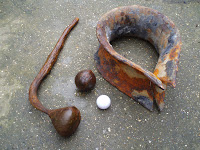
Example of iron work found around the square head of the harbour entrance. using a golf ball to give some idea of the scale. To the left a broken stock from an Admiralty pattern anchor. In the middle an iron ball with a hole running straight through it and on the right a rather large Thimble used in maritime rope work.


A few of the miscellaneous items found inside the harbour when the deep digging was taking place over a week ago.


Monday, 20 February 2012

Wednesday, 15 February 2012

Historical Society AGM April 16th

A quick reminder that the Margate Historical Society AGM will be on the 16th April, in the Cecil Square Baptist Church Hall (entrance New Street) starting at 10am.

Membership cards will be required for voting, if you do not have your renewed membership yet, please contact the Secretary on 01843 223300

Wednesday, 8 February 2012

The Parakeet club and Margate teenage memories of the 1960s

"Unlike teenagers today who seem to meet in pubs and clubs. We used to meet up in Cafe's. The one that I used was the Parakeet in Northdown Road. In those days, it was run by a truly lovely couple called Doug and Pam. They were very tolerant of us and early evening, before the real money spenders arrived, we could sit and chat with a cup of tea and a bowl of chips. There always seemed to be a strange or weird waitress working there, who normally added to the fun of the place. One would be eating your chips as she walked to the table. Another one would disappear for days to London, get stoned, come back and be in a daze for days. Friends were made, relationships developed, marriages, even divorce amongst the older ones.

There were the two Jewish boys who turned up one day with brand new matching cars with consecutive number plates. Barry who married a girl called Iris, who made him change his surname from Plant to Grant. Sadly, Barry went out fishing one day and never came back. A girl called Cristal who had quite a lot of success as a singer. Brenda who worked for the local hairdresser "Monsieur Jacques" He was always referred to in a fake French accent. Jo-Anne, always winning beauty contests at the Lido.Buzz, who worked at a bank, but when chatting up strangers always told them he was a photographer for the magazine Honey.Brian who was a real photographer.

I could go on and on, but would love to know if there are any old “ members “ of the Parakeet “ club “, still around and maybe we could swap memories of a calmer time. "

A teenage memory by Robin Lovell received by email


Saturday, 10 September 2011

Margate Museum open for Heritage Open week

Great News the Margate Museum is open for the Heritage Open days and more, come and see the @talking about my Generation' exhibition on the events of 1964 Mods & Rockers riots. open from 11 til 5pm from today until next Wednesday.

Sunday, 26 June 2011

Margate Historical Society Meeting 14th July 3pm - 5pm

The Margate Historical Society are having a meeting in the Baptist Church in Cecil Square, we are using the big hall at the back entrance, and will be havinf a speaker from Underground Kent see flyer below.

'Thursday 14th July at the Baptist Church, (New Street Entrance) From 3pm till 5pm Margate Historical Society invite you to come and hear about the Society and how to become a member as well as a talk from Barry Stewart of Underground Kent. FREE to Members of the Historical Society, open to non members for subscription of 50p included tea/coffee and biscuits. PLEASE CALL TO BOOK PLACE AS THEY ARE LIMITED ON 01843 223300'

Margate Museum opening 25th June 2011 Tony Ovenden

Today I did my bit as a volunteer for todays opening at the Margate Museum which was also a great opportunity to have a good look around with the intention of seeing what was there from Ramsgate in the Museum archive. It has been four years since I last looked at the archive and it was a bit of a surprise that nothing was dusty and everything was in its place. However, it did take me a while to familiarise myself with the files. It was no surprise the vast majority of the files were Margate related, from Ramsgate there were five main files on Ramsgate in general, two files on Ramsgate pubs, one file on Ramsgate Mayors with research notes and smaller files on subjects like Sally ferries etc., Most of the Ramsgate archive were copy documents all neatly filed with a few photographs and some original material which are all ideal for scanning. Looking at all the files it is clear that the vast majority can be scanned which would easily reduce the storage space by about seventy five per cent or more. The most refreshing thing about the archive being that every part of Thanet is well represented and it all can be scanned and stored on a data base.


There is not much Museum gossip to write about other than that the loans from the Medway Steam Preservation Society are to be returned as the loan period is near the end, which will make some space available in the maritime room.

Overall, the day did go well and considering the economic climate and the pressures on local government finances, I think it is a good idea by TDC to open the Museum to coincide with events using the volunteer base from the Friends of the Margate Museum until firm decisions about the Museum are made.

On July 4th the Friends of the Margate Museum will be having a meeting at the Old Town Hall at 19:30 hrs for those that are interested

Friday, 24 June 2011

Starting Out Again by Tony Ovenden

Following the disastrous fire a few years ago at the Ramsgate library the question that went through the minds of Margate historians was what would we do if the Margate Museum suffered the same fate and how would we react. This led to a great rethink within the Margate Historical Society which by then had become fully independent from the Margate Museum. The decision was to research and publish quality articles and distribute the findings as far and wide as possible. Very much the same as what the Margate Civic Society is doing at present, producing and distributing quality items. So if the hub of information is affected by a disaster then information can be pulled back in and it can be business as usual. A fine example of Margates history stored outside the recognised hub of the Margate Museum and library and how it can be achieved has to be Tony Lee's Margate history website which is featured on my favourites side bar.

However, this does not resolve the problem of replacing artefact's which does sound a daunting task. A key to this is how the Margate Museum developed in the past ten years and how easy it is thanks to the Internet to acquire historical artefact's. In fact it is now possible to set up a Museum on a relatively low budget and with public donations of items the possibility of setting up a collection within a year or so is achievable.

I could never understand why after the fire at the Ramsgate library that the history of Ramsgate as told in artefact's and exhibits sort of died, and when the Maritime Museum closed it seems as if everyone sort of gave up. Exceptions being, Ralph Hoult who happens to have his own private museum, Terry Wheelers fledgling Ramsgate Historical Society and the Ramsgate History forum on the net.

Now that I have settled in as a Ramsgate Town Councillor, I have been slowly but surely going through every single print of Ramsgate on the Internet, looking at where I can source items should I need to, I have also started a database on Ramsgate artefact's, I have started buying in items and I am researching into Ramsgate items in local authority ownership. In fact I am using everything I learnt through experience at the Margate Museum as a Margate Historian and I am now applying it to Ramsgate. I doubt if I will ever be an "expert" on the history of Ramsgate but I do know I have the minerals to do something about its sad decline.


I came across this excellent engraving from the Illustrated London news which is going through ebay at the moment for £18.50, it is so tempting.

Sunday, 3 April 2011

Kent Messenger Ltd: View Picture: LI26672@Margate Bomb damage 5.jpg

Kent Messenger Ltd: View Picture: LI26672@Margate Bomb damage 5.jpg

Margate - LI26672@Margate Bomb damage 5.jpg

LI26672@Margate Bomb damage 5.jpg

Building in Northdown Road, Margate, were damaged when 12 F. W. 190's raided the town on 1st June, 1943. COPYRIGHT KENT MESSENGER GROUP 01622 794667 e-mail picturedesk@thekmgroup.co.uk Picture Services Editor Barry Hollis NO REPRODUCTION OF THIS IM

Saturday, 22 January 2011

Beach Glass

One of the outstanding features of Beachcombing on the Thanet Coast is there is always something to find if you put your mind it. The entire coast like the rest of the UK is a mass of natural history items from the marine environment , natural to a specific area like sea shells for example. Another interest are the historic items that can date back centuries that can be picked up just casually walking on the main sands. One fine example is sea glass or cullet as it is generally known. Some areas of the Thanet coastline have it in abundance, and on certain winds and tides after unsettled weather it is very easy to pick up. Margate main sands is a fine example and this clip from Youtube even though it is from a far and distant beach many miles away in another country typify the finds are what I would expect to find on Margate main sands. In fact I have done exactly that and have built up a almost identical collection. The useful thing about about this clip is that explains how to date pieces of beach glass by the necks. On other youtube clips it is interesting how some people look at beach glass with a artistic eye making interesting jewellery and artistic designs.

Great British Railway Journeys

On Tuesday 26th January at 18:30hrs, Margate will be featured on BBC 2's series Great British Railway Journeys presented by Michael Portillo. The journey is from Canterbury to Margate and I do know that the bathing machine and Benjamin Beale will get a mention as the society has made a cotribution by providing research material for the programme makers.


Monday, 29 November 2010

Building Storeys: The Work of A Buildings Historian

ELLEN: HOUSE HISTORIAN. Read post below and see link for further reading.

Building Storeys: The Work of A Buildings Historian

The Work of A Buildings Historian

Park Street, Mayfair 1901 (Survey of London)
I came to researching historic buildings by accident. All I knew was that I wanted to work with old buildings and play a part in their conservation. I had always loved history; I had always been interested in old buildings and always enjoyed the process of research. But it was only when I studied for a post-graduate in building conservation at the Architectural Association that I realised that there could be a career incorporating all these elements.

I started at the deep end, researching buildings for a firm of conservation architects. I was and am ostensibly an historian but my post-graduate in building conservation gave me that depth of knowledge required by architectural professionals.

Today my clients include architects, property developers, planning consultants as well as private home owners. The latter call on my services for many reasons; mostly just to find out the story of their house, but at other times it is to support a planning application or help settle a boundary dispute.


A house historian will look at dates, people and any stories surrounding the house and occupants. In my work, I also look at what was on the site before construction, who built it, how was it constructed, for whom and why? What was the building used for, what alterations had been made in the decades / centuries since construction? I scrutinise architects’ plans, identify alterations and piece together how the building has evolved. This kind of research aids the restoration, conservation and building process. For instance it can determine the historical importance and relevance of architectural features and whether they can or cannot be altered or removed. Particularly if a building is listed, an in depth knowledge of the building’s fabric is crucial.

One example of my work involved a house in St John’s Wood that had been lived in by a famous artist in the 19th century. It was assumed he had designed it himself and had had the entire building built in 1888. However, my research involving visual inspection and later documentary searches revealed the grand late Victorian house was built partially around a more humble but equally fascinating structure dating to 1825. The conservation / architectural result was that the intended extension had to be modified but in the end the owner achieved what he wanted without disturbing the earlier fabric of the building.

Another example was, a homeowner who had purchased a listed house in Cumberland Terrace in Regent’s Park, built in 1828 and wanted a swimming pool dug in the basement. The opinion was that the listed status was mainly for its external structure and appearance and that the house had been heavily altered internally and therefore the pool should be permitted. However, research revealed the basement floor to be virtually untouched since the late Georgian period and so the owner had to rethink his pool plans. My work is balanced between wanting to conserve the historic fabric of buildings and trying to achieve what the client wants. Ultimately, though, I can only report the facts and from that decisions can be made.


Cumberland Terrace 1938 (Survey of London)
While I work all over the country, I have often been asked to research a Georgian or Victorian townhouse in Belgravia or Mayfair with a view to converting the building back into a single residence (having been converted into flats in the 1950s). In these instances, I would be required to find out the original layout of the building in order to reinstate the plan form, its walls, doorways, windows and sometimes floor levels.

When I research the history of a house I begin by inspecting the premises and getting a feel for the structure. I will then source information at local libraries and archives e.g. maps, parish records, manorial records, electoral rolls, census returns and archived photographs of the building site or area. Depending on the building, a visit to the National Archives at Kew may be needed. In the case of an in depth architectural search, I always visit the Royal Institute of British Architects Library as well.

From these example sources, and many others I call on, I can build and write a history of the building, for the architects or owners. I often liken it to doing a jigsaw puzzle (but without a picture to guide you). Each piece is important, but it is only when you put them all together that the full historical picture of the house is finally revealed.

(This blog first appeared on http://www.francoisemurat.com)

Saturday, 20 November 2010

Tudor House Opening for Christmas

For the details of the Tudor House opening and Museum have a look at the following link.

http://margatearchitecture.blogspot.com/2010/11/tudor-house-opening-for-christmas.html

Sunday, 26 September 2010

Funeral Service Details for Mick Twyman

Please find below the funeral details for Mick Twyman.

The service will take place at the Margate Crematorium on Thursday 30th September at 11.20am and will follow on at Lesters, Ramsgate Road.

Arrangements for Floral tributes to Gore Bros Ltd

Wednesday, 15 September 2010

Mr Mick Twyman Secretary to 2010

It is with a great sadness that we announce the death yesterday (14th September 2010), of Mr Mick Twyman founder member and Secretary of the Margate Historical Society. This was very sudden and we will all miss him and his expert knowledge of Margate and its environs.

He had just completed the October Society Newsletter, which will be published as usual on the 14th October, and we hope to have some additional obituaries to include with this issue. The Society was developing well since the AGM in April and we all had plans to make its archive more accessible and widely used. This will go one in his memory and will be called the 'Mick Twyman Bequest'.

Mick loved Margate with a passion not felt by the many, but he was able by his example to fire others imagination and thirst for history in general and Margate History in particular. We are working on setting up a suitable tribute to the life long work of Mick and anyone wishing to be included should contact The Society via email at margate@tesco.net or margatehistoricalsociety@yahoo.co.uk or call 01843 223300

Please feel free to send your memories of Mick to this blog site, and we will be happy to post them for all to see.


Lynn Jackson
Administrator & Acting Secretary

Thursday, 26 August 2010

Talk on a New Novel & The Shell Grotto: Margate Library

Kent County Council News Release

How was the Shell Grotto discovered?

Local author talk at Margate Library

Sonia Overall will be giving a talk at Margate Library on Thursday 2 September at 6.30pm until 7.30pm. She will talk about her book the The Realm of Shells and the research that she did for it. The event is free but tickets are essential due to space. Tickets available from Margate Library, telephone 01843 223626.

The narrator of Sonia’s second novel, The Realm of Shells, is Fanny Newlove, a young girl who moves to Margate with her family in 1835. The discovery of an underground shell grotto in their new back garden is a catalyst for the unravelling of Fanny's world, as childhood secrets are replaced by adult intrigues and ruthless profiteering. Although a fictional account, the book includes many facts about the story of Margate’s Shell Grotto.

As well as being an author and teacher of creative writing, Sonia Overall has a ‘secret life’ as a street performer and musician. See her website for more information: http://soniaoverall.net/.

For further information please contact Margate Library or Jane Bex on 01843 223626

Monday, 19 July 2010

Service of Commemoration Pilot Officer John L Allen DFC

A Service of Commemoration and Thanksgiving
for the Life of
Pilot Officer John Lawrence Allen DFC
(1916 – 24/7/40)
Saturday, 24th July 2010
2.30pm
Canterbury Christ Church University
Broadstairs Campus
Northwood Road
Broadstairs
CT10 2WA
ALL WELCOME
Tel 01843 609120 for further information

The University’s Chaplain, Revd Dr Jeremy Law will conduct the service to honour John L Allen, in the courtyard of the Broadstairs Campus at 2.30pm on Saturday 24th July. All are welcome to attend and join together in the service of remembrance. Refreshments will follow in the Allen building where attendees will be able to view a small display of documents on John Allen’s life as a WW II pilot. Pilot Officer John L Allen DFC, who has a University building at the Broadstairs Campus named after him,flew with the 54 Squadron and received his DFC (Distinguished Flying Cross) from King George VI only a few weeks before his death. He is also credited with the 54 Squadrons first claim of the war when he shot down a Ju88 in the Dunkirk area on 21st May 1940.
John L Allen’s Spitfire was the first RAF aircraft brought down in Thanet during the Battle of Britain, when on 24th July 1940, at the age of 24 he died when his plane stalled and crash landed into a substation in. Omer Avenue Cliftonville. He was attempting to reach RAF Manston after his Spitfire R6812 had suffered engine damage during combat with a ME 109, flown by renowned German fighter pilot Adolf Galland.
He is buried in a Commonwealth War Grave in Margate Cemetery. His funeral was reported in the Isle of Thanet Gazette on August 4th 1940, which also recorded funerals on the same day of another RAF pilot plus a German pilot, saying: “All three were buried with the homage due to gallant young men”.
Along with many others, John L Allen’s name can also be seen on the “The Battle of Britain Monument London”, first unveiled by Prince Charles and the Duchess of Cornwall on the 18th September 2005. This memorial was built to recognise one of the key battles of World War II and to raise the awareness of its importance amongst subsequent generations.
The Broadstairs Campus will also host a public lecture on Thursday 7th October 2010 on the subject of the Battle of Britain. Military historian Mr Richard C Smith will discuss ‘Memories of the Battle of Britain’, which will include events over the Thanet skies during the Second World War and the role of RAF Manston.
The lecture will take place at the Canterbury Christ Church University’s Broadstairs Campus, Northwood Road, Broadstairs, CT10 2WA. It will start at 6pm and is open to all members of the public. Booking is required in advance.
To book a place and seek or to provide further information about John L Allen DFC
please contact Sharon Quy-Verlander Tel 01843 609120.